(+34) 941 238 261


Denton-Thompson, S. Sayer, E. Soil Systems 6(1), 8 (2022)
https://doi.org/10.3390/soilsystems6010008
Soil micronutrients limit crop productivity in many regions worldwide, and micronutri-ent deficiencies affect over two billion people globally. Microbial biofertilizers could combat these issues by inoculating arable soils with microorganisms that mobilize micronutrients, increasing their availability to crop plants in an environmentally sustainable and cost-effective manner. However, the widespread application of biofertilizers is limited by complex micronutrient–microbe–plant interactions, which reduce their effectiveness under field conditions.
Here, we review the current state of seven micronutrients in food production. We examine the mechanisms underpinning microbial micronutrient mobilization in natural ecosystems and synthesize the state-of-knowledge to improve our overall understanding of biofertilizers in food crop production. We demonstrate that, although soil micronutrient concentrations are strongly influenced by soil conditions, land management practices can also substantially affect micronutrient availability and uptake by plants.
The effectiveness of biofertilizers varies, but several lines of evidence indicate substantial benefits in co-applying biofertilizers with conventional inorganic or organic fertilizers. Studies of micronutrient cycling in natural ecosystems provide examples of microbial taxa capable of mobilizing multiple micronutrients whilst withstanding harsh environmental conditions. Research into the mechanisms of microbial nutrient mobilization in natural ecosystems could, therefore, yield effective biofertilizers to improve crop nutrition under global changes.
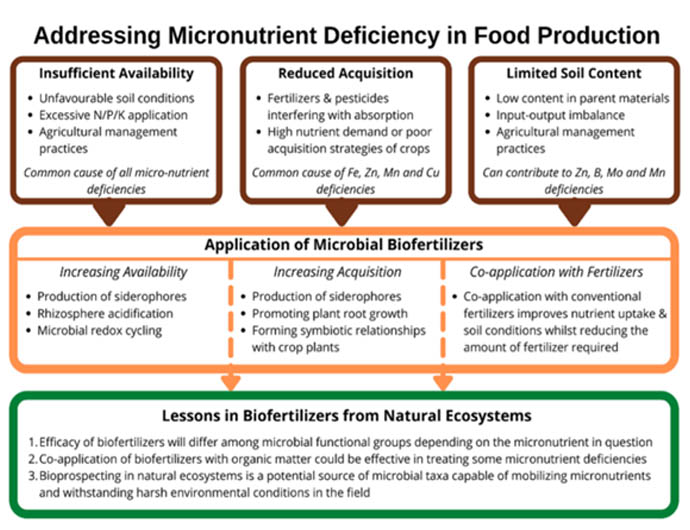
Picture: Conceptual diagram showing the main causes of micronutrient limitation, strategies for alleviating micronutrient deficiencies using microbial biofertilizers, and research considerations for future research into biofertilizers, based on observations from natural ecosystems.
